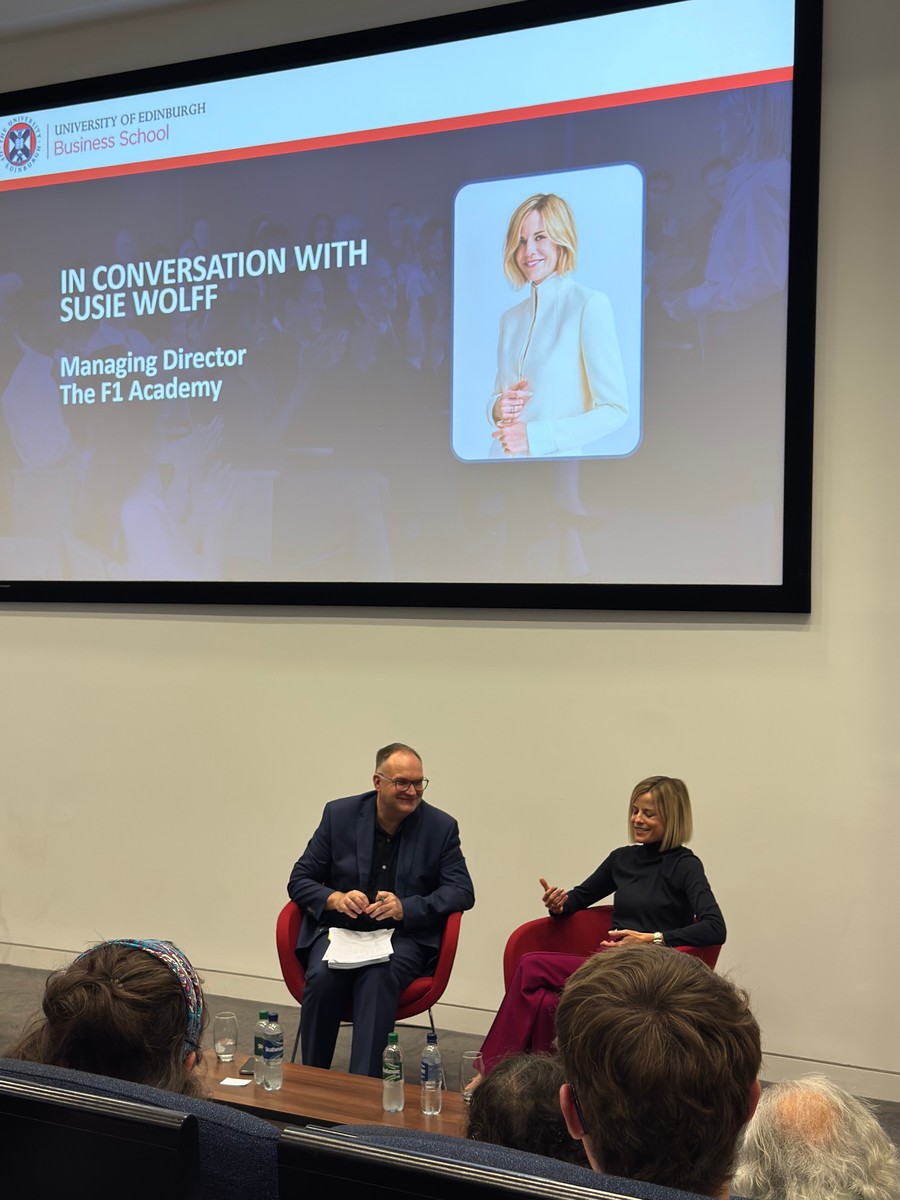
I attended an event this week at Edinburgh University’s Business School with former racing driver Susie Wolff.
I’m a long-time F1 fan and I can remember when she took part in a race weekend for Williams. It was a remarkable achievement. Following racing retirement she became team principal (and part-owner) of a Formula E team, which was eventually sold, and she’s now managing director of F1 Academy as well as being a Netflix star. She’s also a mum, and is married to some guy called Toto.
That’s an impressive resume, and she’s still only in her early 40s! Again, remarkable.
Listening to Susie speak, you understand why she’s been so successful. To survive in the male-dominated, cutthroat world of motorsport as a man must be hard enough, never mind as a woman. Yet she did a whole lot more than just survive, despite the odds never being stacked in her favour. She developed a wealth of grit, determination and tenacity, which she took into the business world with similar ambition and applied it to great effect.
Sure, to succeed you need connections and good fortune as well as all that elbow grease, but Susie’s story shows that hard graft and ambition is non-negotiable.
Her autobiography has just been released (hence this publicity tour) and I’m looking forward to reading it. It has the perfect name for a racer turned entrepreneur – Driven.
As FreeAgent grew, I increasingly worked only superfically on technical stuff which is funny since I was the "chief" (weird) technical "officer" (also weird). I'd still look at code occasionally, but I mainly organised work for other people or sat in meetings discussing the work that other people did. It was necessary I suppose, but a little dispiriting.
For many years I thought that I was done with coding. I didn't think I enjoyed it that much anymore and, hey, I was now a "leader" and had better things to do.
This came to a head at 37signals which was the least technical role I've ever had. At FreeAgent I still had agency to dive into the code, put up my own PRs and make suggestions to others. Not at 37. I was hired for people/management experience, not for technical prowess. I make no claim to having the mad skills of some of the programmers there, but being unable (unwilling I suppose – hello imposter syndrome) to contribute and watching people ship great work made me hungry again.
Since starting an extended sabbatical last summer, I'm back in the code and it's been a revelation! I'm using the same old toolbox (Ruby, Rails) with a new tool (Tailwind) and, crucially, a new colleague in the form of AI – ChatGPT of course and, more recently, Github Copilot. I've found this incredibly productive. The incredible Rails ecosystem allows you to build apps quicker than ever, but the addition of a virtual colleague that can answer (most) questions, deal with time-consuming necessities (e.g. "write some tests for this controller"), and be a sounding board for ideas and questions is a productivity rocketship. It's very hard to get stuck as a solo developer now. Or, rather, it's much easier to become unstuck!
During my sabbatical I plan to build a series of small but useful apps. These are not intended to be much more than side projects, apps you could easily build in your free time as you continue in your day job. Small bets. Hopefully they'll generate a little passive income, but that's useful as validation as much as it is for funding my camera habit.
The first of these was Pagecord which I build in 4 days (it's free). The second, launching today is Teamlight, which took about 3 months (arguably a bit much, but it was on and off). I think Teamlight could be useful for a lot of companies. Here's the pitch:
There's a secret sauce to running a healthy and productive company that is widely overlooked.
Your team is the beating heart of your company, but all too often your people don't know your people. Companies lack a single place to look up who's who, what they do, and what they've been working on.
I built Teamlight to fix that!
Teamlight is a simple, beautiful showcase for your people and their great work. Automatically synced with your Google Workspace.
Bring your team together, today!
Time will tell if any of today's SaaS-fatigued businesses are interested in another tool, however low touch, but as it's an intentionally simple app without too many moving parts, it's easy for me to sustain at low cost with (hopefully!) low maintenance.
If Teamlight is a whopping flop, it doesn't matter. It was fun to build, I learned a lot, and it contributed to my growing library of useful code and patterns that I can apply to the next project.
Speaking of which, I already have the idea for my next app which I plan to get cracking on soon ✨
A question that’s always worth asking yourself: is the time I’m spending doing a particular task or activity well spent? Is it adding value to you or to your business in some way? Before you start work on something, ask yourself the question. In the middle of working on something, pause and ask yourself the question. When you’ve left a meeting, reflect and ask yourself the question. Was it time well spent? If it wasn’t, try and make a change.
Meetings, especially infinitely recurring ones, are a really good test of time well spent. Meetings are typically scheduled for a minimum of 30 minutes, but more often for 60 minutes simply because that’s what Google or Microsoft have decided is the correct default. Parkinson’s Law means that these meetings will last as long as they’re scheduled for, irrespective of whether that is time well spent. It’s probably true that most meetings are not time well spent. You can change that by running better meetings, or by not holding them in the first place. There are alternative and arguably less disruptive ways to share information and make decisions.
It’s not just meetings. It’s all too easy in our hyper-connected, always-on world to spend your time doing routine work, or tasks, that ultimately have no major benefit. Slack want you to be in Slack all day but there’s no difference between being in Slack to being in Facebook or Twitter or LinkedIn all day. You’re just scrolling, channel surfing, waiting for that next dopamine hit – that “interesting article”, that hedgehog gif or an @here that, frankly, can wait until tomorrow. Or the next day. It’s a procrastination drug, a day-long meeting that everyone is participating in. Try turning it off for a while, consume in digests and try and ignore the FOMO.
Just don’t be too hard on yourself. I’ve been writing for twenty minutes and I’m now questioning the value. On reflection the writing practice is good, and maybe the three readers of this blog will take something useful away from the two minutes they spent reading it. I’m calling it time well spent.